
woer
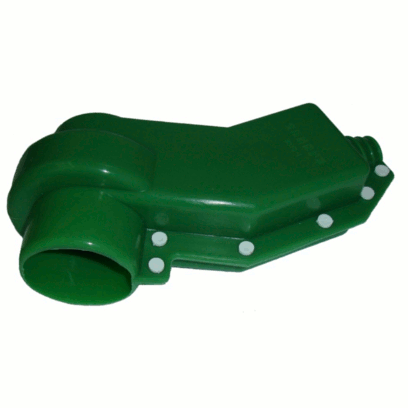
Silicone rubber protective cover
Silicone rubber protective cover
Couldn't load pickup availability
Application areas:
Insulation protection for transformer incoming and outgoing line nodes, individual node protection for indoor and outdoor substations, insulation protection for overhead lines and splicing fittings, etc.
Product Description
-
The protective cover is made of silicone rubber through high-temperature vulcanization and cross-linking molding. This process maintains and improves upon the inherent properties of silicone rubber, resulting in excellent electrical properties, resistance to tracking, halogen-free flame retardancy, excellent weather resistance, high mechanical properties, and hydrophobicity and migratory properties. It is suitable for indoor and outdoor electrical contact protection and can be used continuously in temperatures ranging from -55℃ to 125℃. Installation is simple: clean and tighten the electrical contact, cover it with the protective cover, and fasten the fixing screws. Installation is convenient, simple, and saves time and labor.
The following issues were primarily addressed:
- 1. Prevent short circuits caused by foreign objects overlapping or small animals entering;
- 2. Prevent corrosion of electrical equipment contacts by acids, alkalis, salts, and organic solvents;
- 3. Prevent electric shock accidents to humans and animals caused by exposed electrical contacts;
- 4. Anti-theft electricity function;
- 5. Identify phase sequence;
Product Parameters
-

Technical parameters and test methods
Serial Number Inspection items Inspection standards Test methods 1 Shore hardness HA ≤50 GB/T2411 2 Tensile strength (MPa) normal ≥6.0 GB/T1040 GB/T7141 136℃/168h Aging state K1≥0.8 3 Elongation at break % normal ≥400 GB/T1040 GB/T7141 136℃/168h aging state K2≥0.7 4 Volume resistivity Ω▪cm ≥1.0×10¹² GB/T1410 5 Dielectric strength kV/mm ≥20 GB/T1408 6 Dielectric constant ≤5.5 GB/T1409 7 Dielectric loss factor ≤1.5×10-1 GB/T1409 8 Flammability (FV method) FV0 GB/T11020 Note: K1: Rate of change of tensile strength before and after aging.
K2: Rate of change in elongation at break before and after aging;
Product Selection